




Key Takeaways
- Agentic AI systems plan and execute multi-step tasks autonomously, unlike chatbots or copilots that require constant human direction.
- Agentic AI security is now treated as its own risk category, distinct from traditional application security.
- Human-on-the-loop oversight is replacing manual, action-by-action approval as agent volume scales past what people can review in real time.
- Regulated organizations need a secure, auditable channel for agent escalation and review that goes beyond an access policy on paper.
- Air-gapped and sovereign deployment options let mission-critical organizations adopt agentic AI without exposing operations to public cloud dependency.
Enterprise AI agents are moving out of pilot programs and into daily operations faster than most governance structures can keep pace. Gartner projects that 40% of enterprise applications will integrate task-specific AI agents by the end of 2026, up from under 5% in 2025.
Most companies evaluate that shift mainly in terms of efficiency and cost savings. For defense, government, and critical infrastructure organizations, it’s a different calculation entirely, as sovereignty and auditability must scale together, or the operational risk outweighs the efficiency gains.
What Is Agentic AI?
Agentic AI refers to AI-powered software systems that plan, reason, and execute multi-step workflows, taking action across connected tools and systems using either their own credentials or permissions borrowed from the person who triggered them, with varying degrees of human oversight.
It’s a distinct category from chatbots, which manage conversation, and copilots, which assist a single user’s productivity. Oversight design deserves as much attention as the use case itself. Earlier AI tools like chatbots and copilots only suggested actions for a person to carry out, but enterprise AI agents take actions directly across connected systems.
For organizations running mission-critical infrastructure, that direct action-taking capability is exactly what determines how much scrutiny an agent earns before it’s trusted with real systems.
Where Do AI Agents Create Real Value in Mission-Critical Operations?
The clearest returns show up where agents triage, correlate, and act on high-volume, well-defined signals. That kind of work follows predictable patterns, so a fast, consistent response matters more than a nuanced judgment call.
In mission-critical environments, where delay compounds risk fastest, the benefits of AI agents for mission-critical operations show up in a few concrete ways:
- Incident response coordination: Agents can correlate alerts, timestamp actions, and surface a recommended containment step the moment an anomaly is detected, cutting the gap between detection and first response.
- Security operations triage: Agents can sort high volumes of telemetry into prioritized queues, flagging the handful of events that need human judgment instead of leaving analysts to sift through everything manually.
- DevSecOps workflows: Agents can catch a failing build, pull the relevant logs, and hand a technician a ready diagnosis instead of a raw alert, shortening the time between a problem surfacing and a fix going out.
An agent accelerates the work in each of these areas, though a human still owns the decision, and that decision needs to happen somewhere it can be reviewed later.
Why Does Agentic AI Security Require a Different Governance Model?
Manual approval for every agent action, known as human-in-the-loop oversight, works at low volume but becomes a bottleneck once agents are executing thousands of actions per hour.
Most organizations are shifting toward human-on-the-loop models, where humans define objectives, constraints, and escalation thresholds up front and agents operate independently within those boundaries.
This shift is exactly why agentic AI security has become its own governance category rather than an extension of standard application security. The governance gap gets sharper once you look at whose authority an agent is acting under when it takes action.
Security researchers call this the confused deputy problem, first identified in 1988 and now showing up at enterprise scale as agentic systems take on broader permissions. A trusted agent with wide access can be manipulated into misusing that access on behalf of someone who couldn’t take the action directly, and the resulting log still shows the agent’s own identity rather than the requester’s, giving the action false legitimacy.
CISA’s joint guidance on agentic AI adoption recommends treating each agent as its own scoped identity rather than an inherited extension of whichever user or system invoked it, precisely to close this gap.
Beyond this vulnerability, the broader data on AI governance failures is just as stark. For example, IBM’s 2025 Cost of a Data Breach Report, based on Ponemon Institute research across 600 breached organizations, points to two distinct governance gaps:
- 63% of all 600 organizations studied had no AI governance policy in place.
- Among the 13% of organizations that experienced an AI-related breach, 97% lacked proper access controls for those AI systems.
Enterprise AI agents news continues to highlight this gap, echoed in the joint guidance from U.S. and allied cybersecurity agencies discussed above. Its recommendations center on fail-safe defaults that require agents to stop and escalate uncertain situations to human reviewers, continuous monitoring, and clearly assigned accountability for who reviews those escalations.
Defining an escalation threshold only solves part of the problem, since agents also need somewhere for that escalation to actually happen. When an agent hits a boundary and hands a decision back to a human, that handoff needs a real venue, a place where the escalation is visible to the right people, logged, and resolved with accountability.
A policy that says “escalate to a human” without a complete, exportable audit record behind that escalation stays theoretical, disconnected from what actually happens when an agent hits its limit.
What Happens When an Agent Itself Is Compromised?
Security teams have long treated it as a basic principle that the systems used to defend a network shouldn’t depend on that same network staying intact.
The same logic applies to agent oversight. If an agent or the infrastructure it runs on becomes compromised, the review and escalation channel for containing it can’t live inside the system under attack.
This gap shows up in most current agentic AI guidance, which focuses heavily on prompt injection, privilege escalation, and identity spoofing as attack vectors, but rarely addresses what happens to human oversight once the agent’s own operating environment turns adversarial. At that point, oversight can fail outright, since the same agent or environment you’re relying on to report its status honestly is the thing that’s been compromised.
Detecting that kind of failure means checking the agent’s own account of itself against something it doesn’t control. CISA recommends cross-validating an agent’s reported status against independent system logs rather than trusting the agent’s self-reporting alone, along with reputation and trust scoring that automatically lowers an agent’s privileges the moment its behavior turns anomalous. Neither approach depends on the compromised agent telling the truth about its own condition.
That same principle, verifying against an independent record rather than the agent’s own account, is why audit logs matter here too. Organizations already using audit logs to prove who did what, when it happened, and what the outcome was are well positioned to extend that same discipline to agent actions, treating agent decisions and escalations as auditable events with the same evidentiary weight as any other system log.
How Should Regulated Organizations Deploy Without Losing Data Control?
Mission-critical and defense-adjacent organizations often can’t rely on public cloud dependency for agent oversight, logs, or escalation data, whether due to data sovereignty requirements, classified environments, or frameworks like Cybersecurity Maturity Model Certification (CMMC).
Deployment flexibility matters as much as the AI capability itself, since agentic AI needs to run in the environment an organization already trusts, whether that’s on-premises, private cloud, or fully air-gapped.
That discipline extends to how long agent-generated records stick around as well. Agent decisions and escalations are business records like any other, and they need a purpose-based retention schedule that reflects their actual regulatory purpose rather than whatever default a vendor dashboard happens to keep.
Frequently Asked Questions
Is agentic AI the same thing as an AI agent?
“Agentic AI” describes the underlying capability: goal-driven, multi-step, autonomous task execution. An “AI agent” is a specific instance of that capability deployed for a task, such as an incident triage agent or a DevSecOps assistant.
The terms are often used interchangeably, but agentic AI is the category, and an AI agent is the implementation.
How is agentic AI security different from traditional cybersecurity?
Agentic AI security addresses risks unique to autonomous, action-taking systems. These include agent identity and permissions, prompt injection, and cascading failures across multi-agent chains. Standard application and network security controls weren’t designed for systems that initiate their own actions, so agentic AI security layers on top of those controls rather than replacing them.
Who should own agentic AI governance inside an organization?
Ownership typically spans security, IT, and compliance, with security defining guardrails and monitoring behavior, IT managing access and infrastructure, and compliance verifying that the approach satisfies regulatory obligations. Without a named owner, escalation thresholds and audit requirements tend to fall through the gaps between teams.
What’s the biggest mistake organizations make when rolling out agentic AI?
Writing governance policies without building the operational system to enforce them. A written escalation threshold means little without a secure, logged venue where that escalation actually happens, and the gap between documented intent and enforced practice is where most agentic AI risk lives.
Mattermost: A Secure Foundation for Agentic AI Oversight
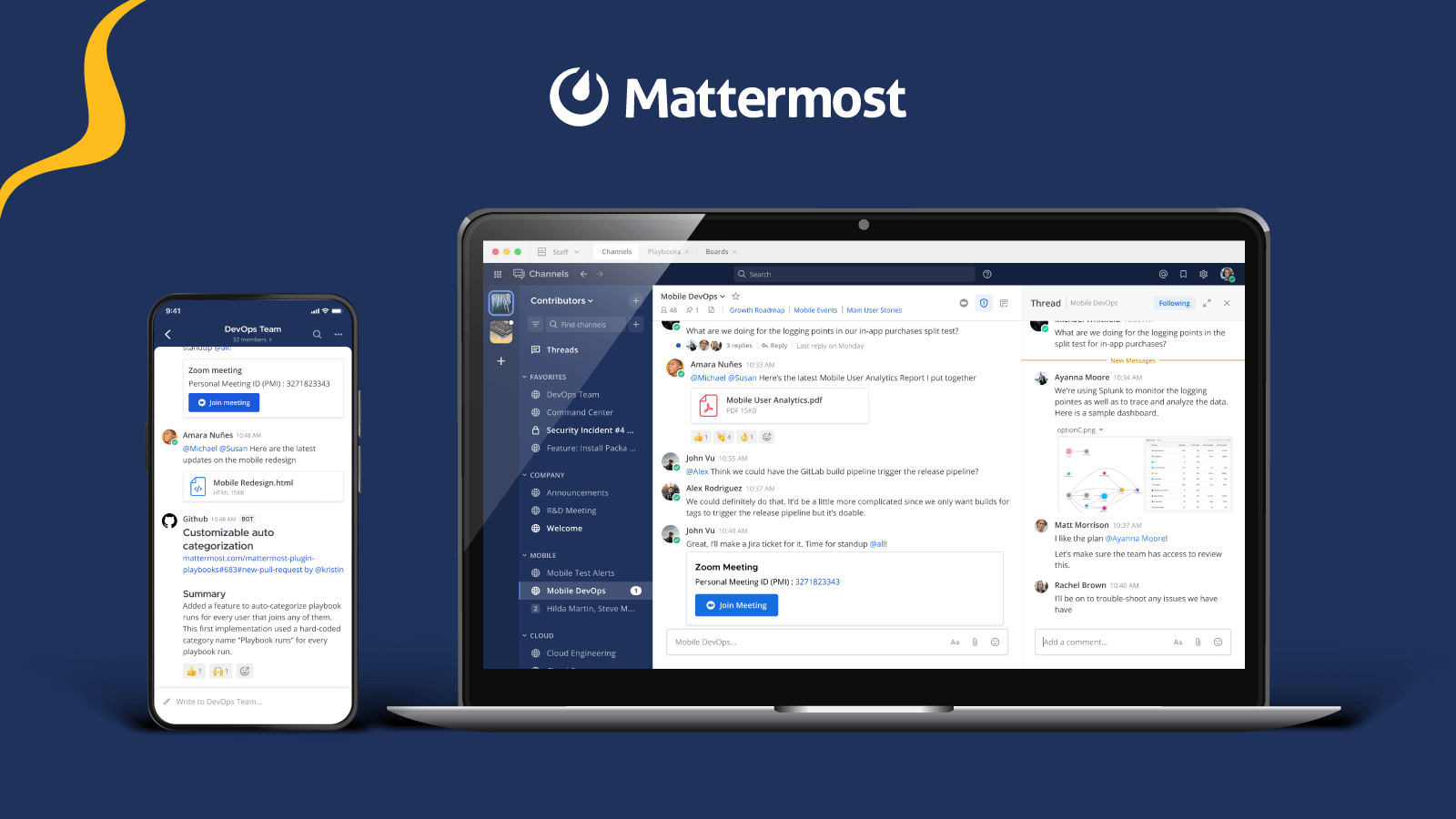
Mattermost brings agent oversight, escalation, and audit logging into the same secure, self-sovereign collaboration environment mission-critical organizations already rely on.
This environment deploys on-premises, in a private cloud, or in fully air-gapped environments, matching whatever infrastructure an organization already trusts. Mattermost Agents V2 puts these principles into practice directly, as each agent’s tool access is scoped individually rather than inherited broadly, and when an agent proposes a tool call, it surfaces in the same channel for the person who initiated the work to approve before it executes.
As enterprise AI agents become part of daily operations, this combination gives humans a place to review agent actions and handle escalations out of band from the systems agents operate in (a natural extension of Mattermost’s Out-of-Band Incident Response architecture), with a complete record of who reviewed what and when.
Learn more about how Mattermost Agents support secure, mission-critical AI-accelerated operations.
If you’d like to see Mattermost in action, please sign up for a free trial.