

Key Takeaways
- Most AI stacks assume live internet access for the model, retrieval, and updates; air-gapped infrastructure removes that assumption entirely.
- Unlike a network with a restricted outbound gateway, a genuinely air-gapped network has no route to the outside at all.
- Agentic AI can run entirely within an air-gapped boundary when the model, retrieval layer, and tools are all staged locally in advance.
- Self-hosted, open-weight models are the standard choice for air-gapped agents because they never depend on an external API to respond.
- Governance requirements, like scoped agent permissions and audit logging, still need enforcement inside the boundary even after isolation is in place.
Agentic AI conversations tend to assume a live internet connection. The AI model calls a cloud API for every response, the agent pulls from a hosted vector database, and the model itself receives patches and version updates automatically over the network. The real question is whether the model, the tooling, and the data it touches can operate entirely inside a sealed network boundary.
This assumption breaks down completely for defense agencies, intelligence services, and critical infrastructure operators running on classified or air-gapped networks.
Defense agencies and critical infrastructure operators still need AI that can summarize documents, answer questions, and take action inside workflows, but commercial, public models are not available to them. While lack of connectivity is the obvious limitation, a second critical reason is the suitability of the AI model itself. These organizations have unique vocabulary, jargon, constraints, and metrics and their models must leverage them to be effective.
Gartner predicts that at least 80% of governments will deploy AI agents to automate routine decision-making by 2028, and that adoption curve is already steep inside classified networks: the Pentagon’s GenAI.mil platform reportedly grew to more than 103,000 agents within five weeks of launch.
What Do Most AI Models Need Internet Connectivity For?
Most AI models need internet connectivity for three things: calling a cloud-hosted inference API to generate a response, querying a hosted vector database for retrieval, and receiving model updates and patches pushed automatically from the provider. Agentic systems add a fourth: live calls to external tools and services.
None of this is unique to agentic AI. Nearly every modern AI product, from a chatbot to a coding assistant, is built on the same four dependencies. What changes for agentic systems is that the fourth dependency, live tool calls, multiplies. For example, an agent might call a ticketing system, a code repository, and a search API in the course of a single task.
Air-gapped environments remove all four of these dependencies at once, which turns agentic AI there into a genuinely different engineering problem. Some organizations solve that problem by building and hosting everything themselves. Others increasingly turn to the major cloud providers, who now package the same disconnected architecture as a supported product.
Major cloud providers now handle the hardware layer for the same self-hosted components described in the next section, offering AWS Bedrock in AWS’s air-gapped Top Secret and Secret Regions, Azure AI’s disconnected containers built to run fully offline, Google Distributed Cloud’s air-gapped Vertex AI appliance, and Oracle’s dedicated, air-gapped Isolated Region.
What Is Air-Gapped AI Infrastructure?
Air-gapped AI infrastructure is a completely self-contained computing environment, physically and logically isolated from the internet, that hosts AI models and agents entirely on local hardware. No NAT, external DNS, or outbound network path exists for data to leave, or for updates to arrive automatically.
In practice, that means the inference engine, model weights, retrieval layer, and any tool connectors an agent uses all run on hardware inside the same boundary. Nothing about the deployment assumes it can reach an external service to function.
This zero-connectivity standard is stricter than an “isolated” deployment, which still uses a restricted gateway for outbound traffic. The distinction has real operational consequences beyond terminology.
Regulated and classified programs often require the stronger, air-gapped standard rather than a segmented network with an egress allowlist. For agentic AI, every one of those components—the inference engine, the vector store, and the connectors—must be pre-staged within the boundary, since there’s no fallback route to an external service.
Can Agentic AI Work in Air-Gapped Environments?
Yes. Agentic AI can operate in air-gapped environments, provided the model, inference layer, and every tool the agent calls runs entirely inside the network boundary. The agent takes actions and answers questions using only what already exists inside the boundary enclave, with no call to an external service.
Most cloud AI deployments don’t meet a requirement this strict.
A typical enterprise AI stack defaults to a hosted model, a managed vector database, and third-party plugins. Making agentic AI work in air-gapped environments means replacing every external dependency with a local equivalent before the agent runs its first task.
How Do You Manage AI Models Without Internet Access?
An air-gapped AI deployment manages models through self-hosted, open-weight files updated on a controlled, scheduled cadence. Teams validate each new version inside the boundary, run regression tests against known tasks, and keep the ability to roll back if a version underperforms.
Model management inside the boundary generally comes down to four practices:
- Choose self-hosted, open-weight models: Open-weight model families run entirely on local hardware, so the agent never depends on an external API to generate a response.
- Set a controlled update cadence: Most air-gapped deployments refresh models monthly or quarterly through the same approved transfer process used for other software, with an expedited path reserved for urgent fixes.
- Run regression tests before promotion: A new model version gets evaluated against a known set of tasks inside the boundary before it replaces the version already in production.
- Keep multiple model versions available: During a transition, running the outgoing and incoming versions side by side supports rollback if the new version regresses on a task the team relies on.
What Risks Doesn’t Air-Gapped Deployment Mitigate?
Choosing an air-gapped AI solution addresses network exposure, but agent behavior still needs its own guardrails. Agents need permissions scoped to the user’s own access, and every prompt, response, and tool call needs logging, since isolation alone cannot prove what the agent did inside the boundary.
Data residency laws and classified handling rules explain why organizations choose air-gapped deployment, though those requirements alone don’t stop an agent from accessing more than it should once it is running inside the boundary. Permissions scoped to the invoking user, combined with a complete record of every action the agent takes, are what let a security team prove after the fact that it stayed within its intended role.
Frequently Asked Questions
Is air-gapped AI the same as on-premises AI?
No. On-premises AI runs on infrastructure the organization owns, but it can still connect to the internet to access a cloud model or update service. Air-gapped AI has no network route to the outside at all, so every dependency has to already exist inside the boundary before it runs.
What models can run in an air-gapped environment?
Open-weight model families such as Cohere, Mistral, and others are the most common choice for air-gapped agents, since they run fully on local hardware without calling an external API. Some deployments also support approved cloud-hosted models when the environment permits a tightly controlled, monitored connection.
How often can you update an air-gapped AI model?
Most air-gapped deployments update models on a monthly or quarterly cadence, since new versions move through a controlled transfer process rather than an automatic download. Teams reserve an expedited path for urgent security patches so a critical fix does not have to wait for the update cycle.
Is agentic AI secure enough for classified environments?
Agentic AI can meet classified security requirements when the model, tools, and data all run inside the approved network boundary with no external dependency. Security depends on scoping agent permissions to the invoking user, logging every action the agent takes, and validating each model update before deployment.
Mattermost: Agentic AI Built for Air-Gapped Operations
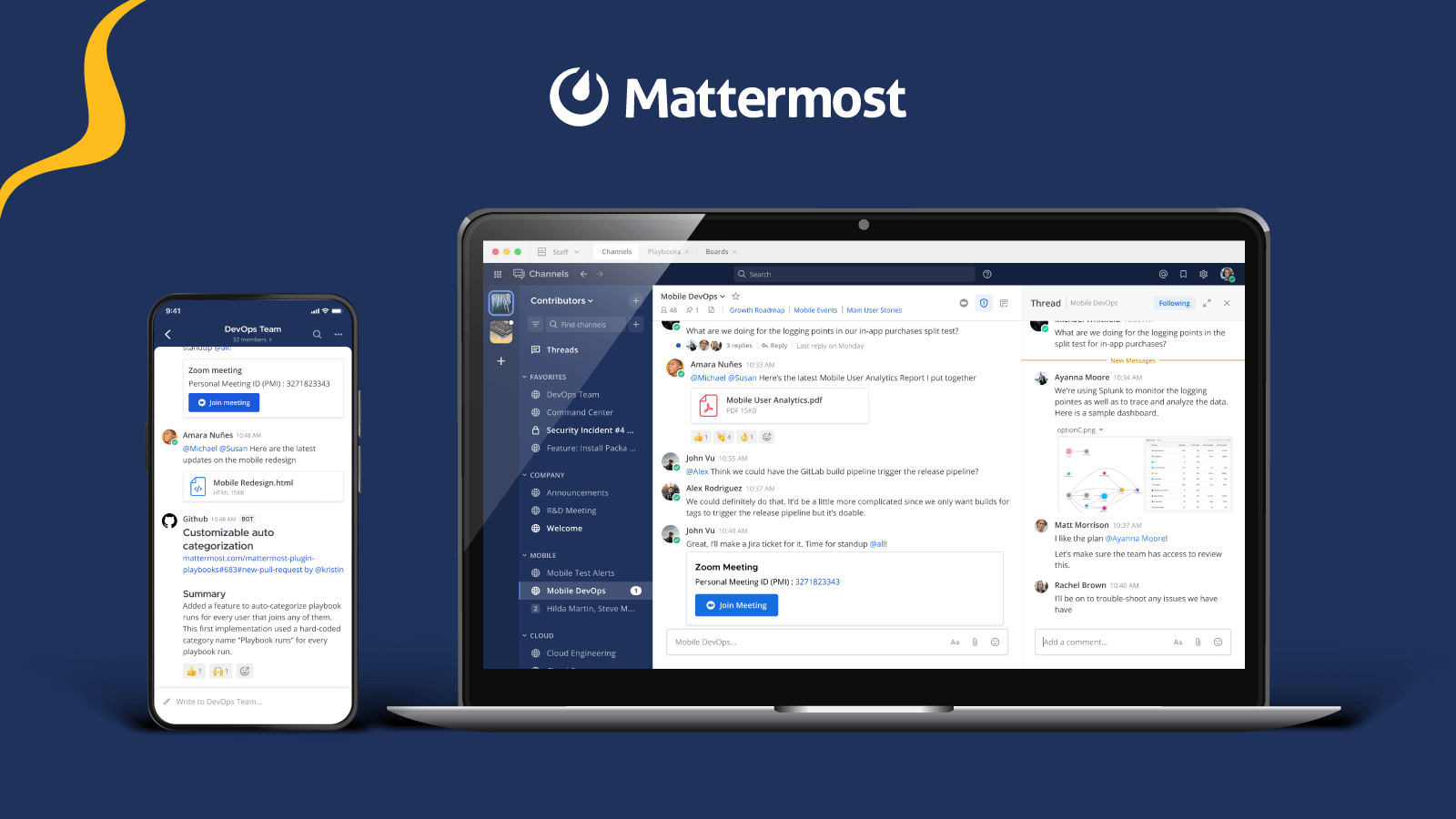
Built for exactly this kind of disconnected operation, Mattermost is an Intelligent Mission Environment that can deploy fully air-gapped without reliance on internet access, external DNS, or cloud authentication.
The Mattermost Agents plugin connects to self-hosted, open-weight models running inside that same boundary. Mattermost Channels, Mattermost Playbooks (Enterprise and Enterprise Advanced), and Mattermost Calls (including AI-generated call summaries on Enterprise and Enterprise Advanced) support the same isolated infrastructure, giving defense, government, and critical infrastructure teams a self-sovereign foundation for command and control: their data, keys, and environment.
Learn more about self-sovereign collaboration with Mattermost today. While you’re at it, experience a free 1-hour preview environment for self-sovereign collaboration and see Mattermost running fully air-gapped.