
The LISA Consortium replaces Slack with Mattermost for data sovereignty
“Mattermost has been very reliable for us, and reliability is key for this multi-decade project.”Niels Warburton Spokesperson, LISA Consortium

Highlights
- Moved from Slack to Mattermost for data sovereignty
- Self-hosted Mattermost for control and flexibility
- Accelerated complex scientific collaboration for a global team
Integrations

The Laser Interferometer Space Antenna (LISA) Consortium supports the LISA mission, which will become the world’s first space-based gravitational wave observatory, designed to detect gravitational waves in space.
“The LISA mission will detect ripples in the fabric of space and time coming from sources such as merging supermassive black holes, white dwarf binaries in our galaxy, and the origin of the universe,” explains Niels Warburton, spokesperson for the consortium.
Working alongside the European Space Agency (ESA) and NASA, the international consortium consists of over 1,000 volunteer scientists, researchers, and engineers. Operating independently from the space agencies, the LISA Consortium supports the development and scientific goals of the LISA mission, which is expected to launch around 2035 and last four to six years.
Keeping a globally distributed team aligned
To advance its research, the consortium organizes its work into project-based teams housed within larger working groups — like Astrophysics, Communications, Data Analysis, and Fundamental Physics.
“Working groups typically have hundreds of members, and projects vary from a few to many tens of members,” Warburton says.
In the consortium’s early days, project coordinators and working group co-chairs primarily used email and video calls to stay connected with members.
“The latter is particularly challenging given members span locations from the Americas to Europe to Asia,” he continues. “Finding a meeting time that works for everyone is almost always impossible. Email works for asynchronous discussion, but complex discussions quickly become difficult to follow and often more people are involved in email threads than need to be once discussions get down to the details.”
Searching for a secure collaboration solution: Moving from Slack to Mattermost
To solve these challenges, the LISA Consortium began using Slack.
“This was not satisfactory as the message history was excessively limited and there was no self-hosting option,” Warburton adds. “As a result, Slack wasn’t used by many of our members.”
To replace Slack, the consortium started looking for a secure collaboration solution that delivered data sovereignty — full control over their messaging data, files, and documents.
“Data sovereignty is crucial for us because we’re tackling long-term research problems,” he explains. “Members of the consortium will spend years tackling cutting-edge research problems, and it will be important to have access to the history of our conversations across the course of the mission.”
Ultimately, the team moved from Slack to Mattermost.
“Some of our members had been using Mattermost Entry to coordinate a small project for the Black Hole Perturbation Toolkit,” he says. “Mattermost quickly became the default, indispensable method of communication among that group, which is the primary reason we selected it. Much scientific software is released as open source, too, and we were drawn to Mattermost’s open source development model.”
Discussing complex topics easily & building a global community
The LISA Consortium self-hosts Mattermost, which gives them the control, flexibility, and operational resilience required to support its mission, enabling seamless global collaboration in the pursuit of new discoveries about our universe.
“Mattermost has been very reliable for us, and reliability is key for this multi-decade project,” Warburton continues, adding that the team hasn’t encountered a “single bug or issue over multiple years.”
Within Mattermost, the consortium has a dedicated space where all members can share scientific discussions, job opportunities, and upcoming conferences. Leadership and management also use private channels to have more sensitive discussions. Each working group has its own team, with channels used to coordinate projects and keep research moving forward.
With over 1,000 members, the consortium also values Mattermost’s AD/LDAP integration, which automatically syncs users from AD/LDAP groups, something that would be impractical to manage manually, Warburton explains.
For technically complex work, the group values Mattermost’s support for LaTeX, which makes it easy to format and share mathematical equations directly in conversations.
“This is very helpful for complex theoretical discussions about solving the Einstein field equations of general relativity,” Warburton adds.
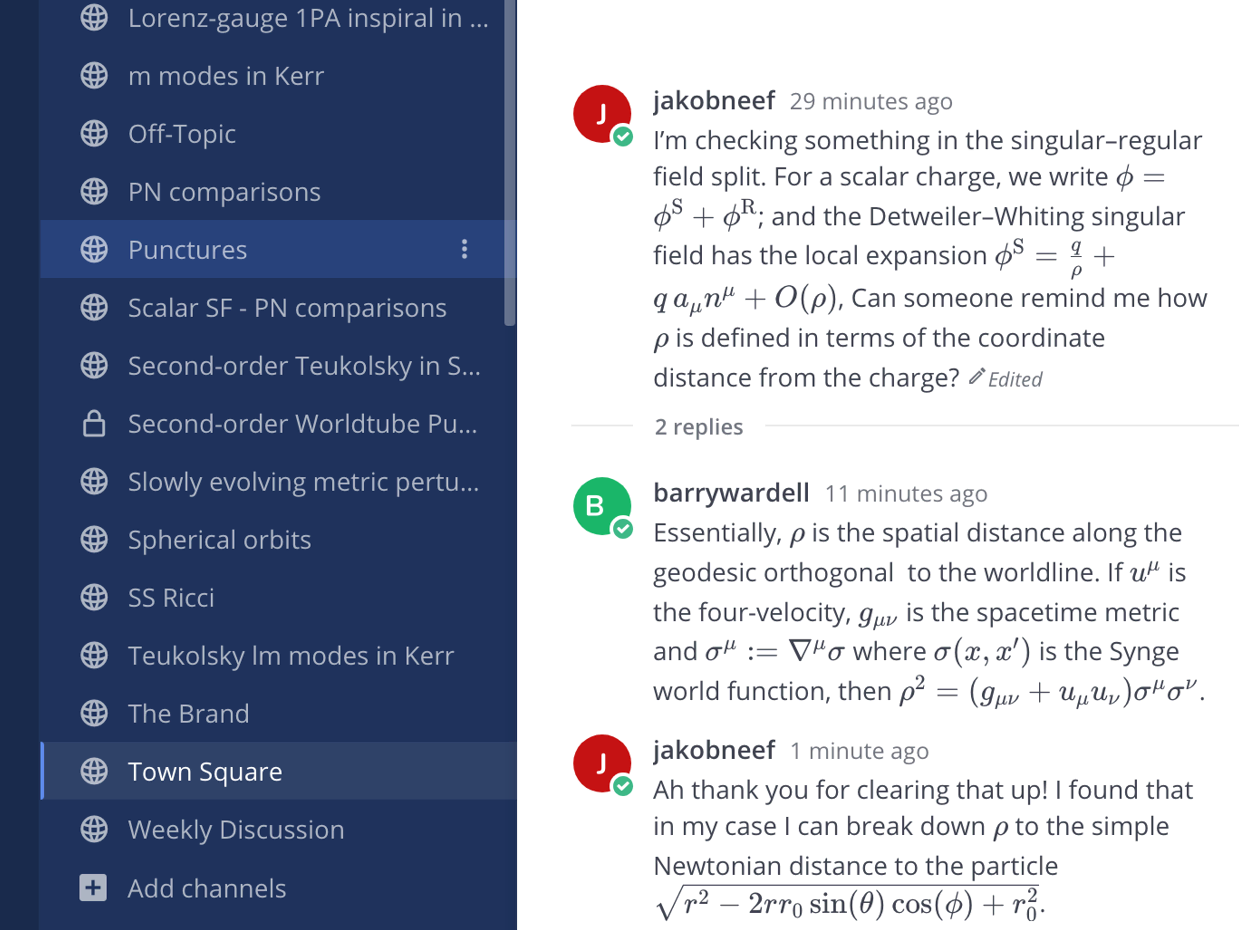
With Mattermost, members no longer have to decipher hard-to-follow email chains to collaborate on complex topics.
“Mattermost makes it easy to have discussions among large groups of people and for side discussions to form naturally via message threads,” Warburton says. “There is a clear productivity gain in communicating this way. It’s clearly more efficient than using email.”
Mattermost also helps the global organization stay connected as a community.
“The ease of communication using Mattermost also helps us build a sense of community amongst our members — which can be a significant challenge since everyone’s spread out across the world.”