



Choosing a collaboration platform feels like a straightforward decision where you evaluate features, check security certifications, confirm deployment options, and sign the contract.
The problem is that most platform decisions are made for today’s requirements, not tomorrow’s threat landscape, regulatory environment, or AI capabilities. For defense agencies, government departments, critical infrastructure operators, and cybersecurity teams, this gap can carry real consequences — and when a platform hits its limit during an incident, a regulatory audit, or a forced migration, the consequences of being wrong are already locked in.
To protect your organization, it’s essential that you know how to choose a future-proof collaboration platform.
What Is Secure Collaboration?
Secure collaboration is the practice of enabling real-time communication, file sharing, and coordinated workflows on infrastructure that enforces access controls, data custody, and auditability.
For sensitive sectors such as defense, government, and critical infrastructure, the platform itself cannot introduce liability through third-party data exposure, compliance gaps, or single points of failure.
Secure collaboration software in these environments must go beyond encryption in transit. Full control over where data lives, who governs the infrastructure, and how the platform integrates with existing security toolchains without introducing new attack surfaces or jurisdictional exposure is the baseline requirement.
How Do Collaboration Platforms Fail Over Time?
Platform failures in mission-critical environments rarely announce themselves at procurement. They surface later, under pressure, when the gap between what a platform promised and what it can actually deliver becomes an operational liability. Three recurring patterns illustrate how this plays out.
1. Data residency is mistaken for data sovereignty
Consider an organization that stores sensitive communications with a U.S.-based cloud provider in a European data center, believing local data residency satisfies sovereignty requirements. It does not.
The Clarifying Lawful Overseas Use of Data (CLOUD) Act allows U.S. authorities to compel U.S.-controlled providers to hand over data regardless of physical storage location, often under a gag order that prevents the provider from notifying the customer.
2. A compliance requirement arrives that the platform can’t meet
Platform fit can also erode quietly over time as the regulatory environment shifts. A platform that was the right fit three years ago can hit a compliance wall when a new requirement demands configurable data retention, eDiscovery support, or air-gapped deployment — none of which the vendor’s multi-tenant SaaS architecture was built to support.
The organization ends up choosing between a workaround it cannot fully defend in an audit and a migration it had no budget for.
3. AI agents are deployed before anyone evaluates AI governance
A third failure mode plays out when AI capabilities are added to a collaboration environment after it has already cleared governance review. The platform was properly evaluated and approved, but AI features arrived later, outside the original review scope. Consider a security team that deploys AI agents to accelerate incident response workflows. Those agents have access to message history, ticketing systems, internal documentation, and potentially customer data — sensitive operational data that now flows through whatever infrastructure the vendor’s AI stack runs on.
If that infrastructure sits outside the organization’s control, sensitive operational data is flowing through third-party infrastructure bypassing retention policy, audit review, and more.
All of the examples above are the consequences of evaluating a collaboration platform against today’s requirements without accounting for how threat models, regulatory environments, and technology landscapes evolve.
Read more about the sovereignty gap nobody talks about.
The Key Risks That Expose Collaboration Platforms Over Time
The examples above share a common root in platforms selected for current capability without evaluating structural durability. The following four risks account for most of the gap between what organizations expect from secure collaboration software and what they eventually discover their platform cannot deliver:
Risk 1: Jurisdictional Exposure
Data residency and data sovereignty are distinct concepts that procurement processes routinely conflate. Data residency refers to where data is physically stored; data sovereignty refers to who holds legal authority over it.
For organizations using U.S.-controlled providers, jurisdiction follows corporate ownership rather than server location. For example, Microsoft France’s director of public and legal affairs confirmed under oath in 2025 that Microsoft cannot guarantee French customer data would never be transmitted to U.S. authorities if the U.S. government issued a legally justified order — despite technical and contractual safeguards the company has put in place.
Austria’s Ministry of Economy, Energy, and Tourism reached the same conclusion independently. In choosing a self-hosted, open-source collaboration platform, the Ministry’s CISO explained: “It was never about saving money. It was about maintaining control over our own data and our own systems.”
A sovereign collaboration platform resolves this exposure by placing infrastructure governance entirely within the organization’s control.
Risk 2: Vendor Lock-In
Proprietary APIs, formats, and contract structures quietly eliminate exit options over time. The true cost of switching becomes visible only when market conditions change through pricing leverage, product discontinuation — as users of Skype and Google Hangouts discovered — or a vendor roadmap that no longer fits the organization’s security requirements. AI has made this risk substantially more complex.
Organizations building agentic workflows around a single vendor’s model stack create a second layer of dependency on top of the platform itself. Rebuilding those workflows on a new model stack carries its own migration cost.
An organization that has locked into both a proprietary collaboration platform and a proprietary AI stack has effectively constrained its infrastructure decisions twice.
Risk 3: Deployment Inflexibility
A platform restricted to managed SaaS delivery becomes a hard ceiling as requirements evolve. Geopolitical risk, tightening compliance obligations, and the growing demand for sovereign infrastructure are pushing sensitive-sector organizations toward on-premises, air-gapped, and sovereign cloud deployments at an accelerating rate.
The sovereign cloud market is projected to grow from $195.35 billion in 2026 to $1.32 trillion by 2034, according to Fortune Business Insights. Waiting until air-gapped or sovereign deployment becomes a mandatory requirement means undertaking a forced migration under operational pressure rather than a planned transition on the organization’s own terms.
Risk 4: Compliance Drift
GDPR, NIS2, CMMC 2.0, Schrems II, and sector-specific regulations evolve continuously, and multi-tenant SaaS platforms built for general enterprise use consistently lag in bespoke compliance needs.
General-purpose vendors rarely build for the architecture that those requirements demand. For example, configurable retention periods, message-level audit logs, eDiscovery integrations, and controls for controlled unclassified information (CUI) are often deprioritized when your product is designed for the broadest possible market.
Organizations absorb the shortfall through workarounds that accumulate into technical debt, exceptions that undermine audit defensibility, and migrations that arrive as emergencies rather than planned upgrades.
What a Future-Proof Secure Collaboration Platform Looks Like
A future-proof sovereign collaboration platform for sensitive sectors is defined by its architectural flexibility over time. The capabilities that matter are the ones that keep the organization in control as requirements change, not the ones that look strongest on a procurement scorecard today.
Learn more about the top five qualities you should look for in a future-proof collaboration platform:
- Deployment flexibility and cloud neutrality: The platform should run across any environment the organization requires, whether public cloud, private cloud, on-premises, air-gapped, or sovereign. Workloads should be movable between environments without rebuilding the platform. Cloud neutrality (meaning no architectural dependency on a specific cloud provider) is what separates genuine deployment flexibility from a vendor claim.
- Open core architecture and data portability: Open source or open core platforms allow organizations to audit the codebase, verify security controls, and avoid proprietary lock-in at the infrastructure layer. Data should be exportable in open formats so that if the vendor relationship ends through pricing changes, acquisition, or end-of-life, the organization retains full access to its history and can migrate without prohibitive switching costs.
- Customer-controlled encryption and data custody: The organization should hold its own encryption keys. Customer-managed keys ensure that even under a compelled-disclosure scenario, the provider cannot produce readable data. Full data custody (i.e., communications, files, and metadata remain on organization-controlled infrastructure) is the architectural baseline for mission-critical environments.
- Extensible integration architecture: Open APIs and webhook support allow the platform to connect with the security toolchains, SIEM systems, and operational tools the organization uses today and will adopt in the future. Closed integration models create a ceiling that becomes more costly the longer the organization stays on the platform.
- Governed AI integration: Organizations should be able to integrate AI capabilities without routing sensitive operational data through third-party AI infrastructure. Support for self-managed or on-premises AI models, model flexibility, and auditability of AI access to communications data are the characteristics that distinguish a platform built for AI governance from one where AI was added as a feature.
Mattermost: A Sovereign Collaboration Platform Built for Sensitive Sectors
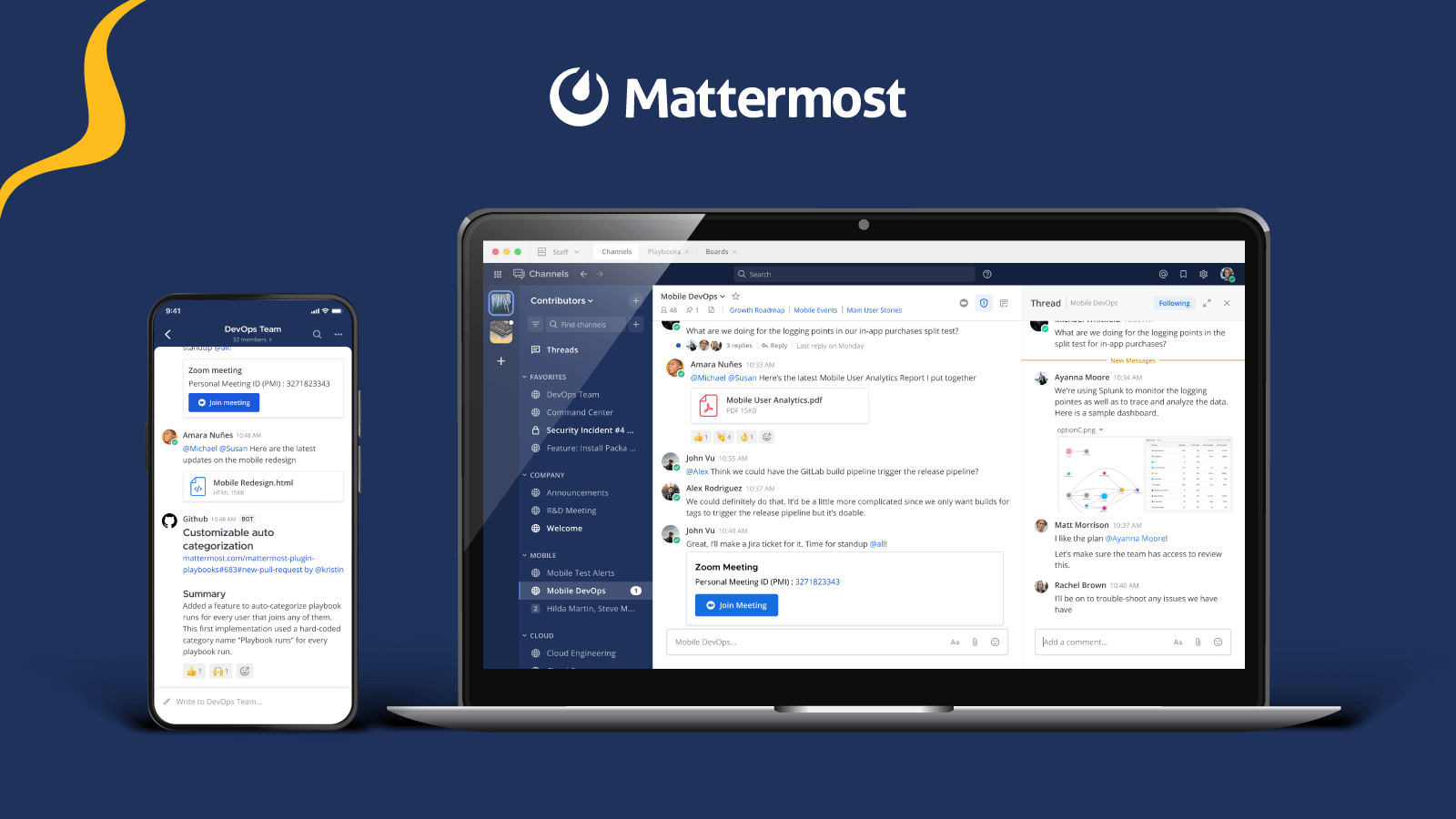
Mattermost is purpose-built for organizations where the collaboration platform must be as secure, controllable, and resilient as the infrastructure it supports.
Flexible deployment across public cloud, private cloud, air-gapped, and on-premises environments gives defense, government, and critical infrastructure teams full data custody, customer-controlled encryption, and an open core architecture that avoids vendor lock-in at both the platform and integration layers.
Mattermost Agents supports governed AI integration, including self-managed on-premises models, so teams can bring AI capabilities into mission-critical workflows without ceding control of sensitive data.
Learn more about Mattermost’s sovereign collaboration platform. If you’d like to see our platform in action, please sign up for a free demo.