



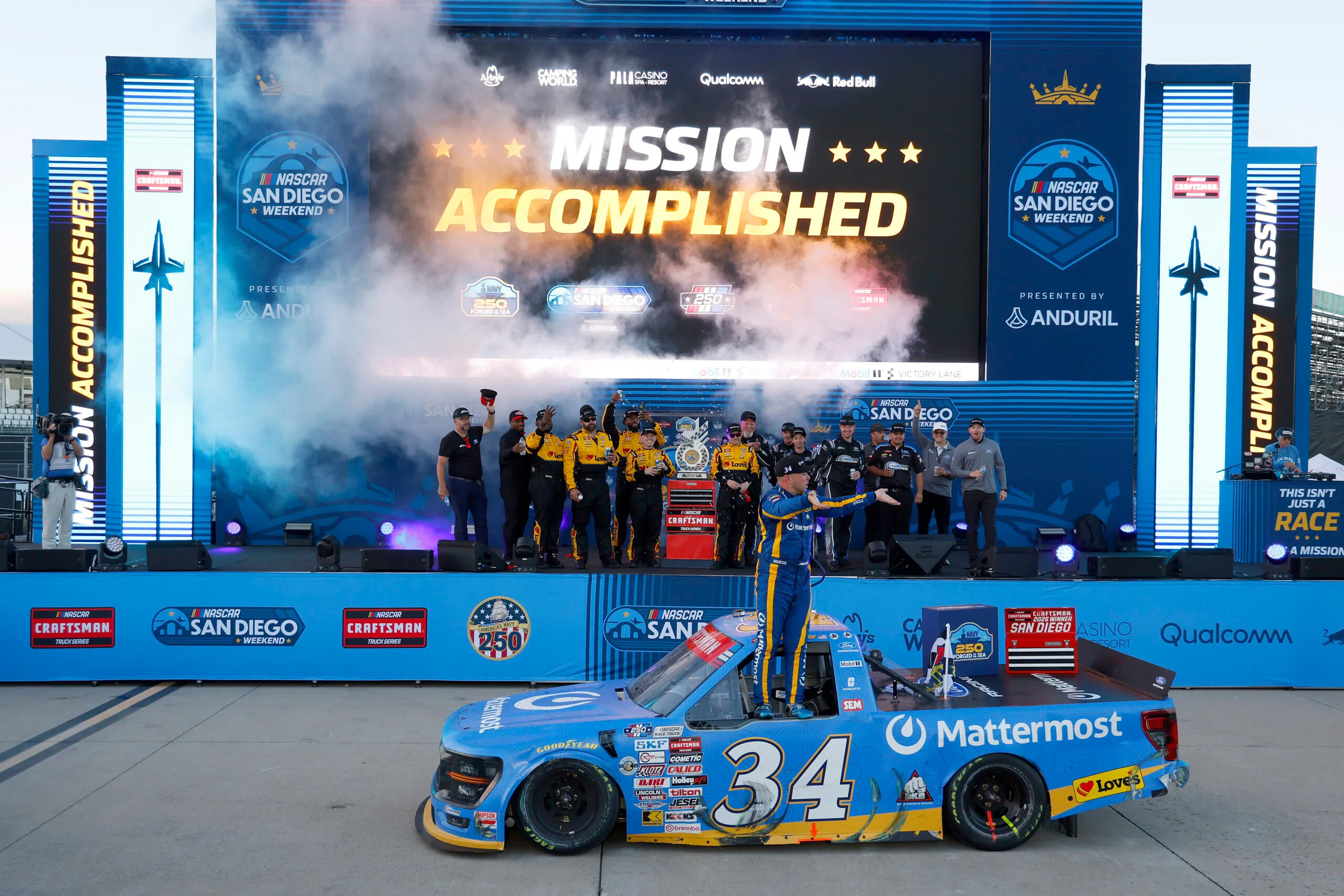
When Layne Riggs crossed the finish line at Naval Base Coronado on June 19, the cameras found him. They always focus on winning drivers.
But the story that actually won that race started long before the green flag dropped. It flowed over headsets and data feeds, rooted in hundreds of fast decisions made by people you’ll never see on the broadcast.
Most organizations think they have a communication problem. The best NASCAR teams know they have a coordination problem — and there’s a difference.
The Race Behind the Race
As the cameras tracked the No. 34 Ford, something far more complex was happening off-screen: a distributed team of specialists who rarely find each other in the same room were functioning like a single brain.
Engineers were watching tire data in real time, strategists were laser-focused on fuel calculations, and crew chiefs were tasked with translating chaos into 12-second pit stops. Each of these groups was operating in different locations under the persistent force of race-day pressure.
In NASCAR, coordination failures are visible and immediate. A missed cue or late strategy call translates directly into lost positions, and there’s no recovering the lap.
After Coronado, Riggs said that he was “just driving with his heart.” That kind of instinctive performance doesn’t happen in a vacuum. It’s the product of a team that’s already solved every problem it could before the race started.
More than a sports metaphor, this sophisticated coordination — the kind winning NASCAR teams have turned into an art form — is a blueprint for any high-stakes operation where decisions can’t wait, mistakes compound quickly, and everyone needs to know their role without being told twice.
The Operation Behind the Operation
Every high-performing organization has a version of this problem: distributed people, real-time decisions, and consequences that escalate rapidly when coordination breaks down.
The best teams solve it the same way NASCAR does: by building infrastructure that makes coordination seamless and automatic. Think clear roles, shared context, and workflows that let people move fast without disrupting everyone around them.
That infrastructure is also entirely proprietary. NASCAR teams don’t hand their race strategy to a third party. Their telemetry and communications — the competitive edge — is theirs and theirs alone.
In a sport where milliseconds separate the field, that wholly owned intelligence is the competitive moat. Giving it away, even to a trusted partner, is giving away the race before it starts.
The same logic applies to how elite organizations choose their tools. Ownership isn’t just a preference but a requirement. Teams that control their own systems control their own outcomes; those that don’t are forced to hand over the very intelligence that drives their decisions.
This is the principle behind Mattermost, a secure collaboration platform built for teams that operate under pressure and can’t afford to lose control of their data or their decisions. Like the crew chief with a headset, Mattermost exists to make sure the right information reaches the right person at the right moment — every time.
It’s the same need whether you’re running a defense operation, a hospital, a financial trading floor, or an engineering team managing critical infrastructure.
After the checkered flag drops, the spotlight always finds the winning driver. But the teams that keep winning are the ones who’ve built something that most people never see: a coordination layer that remains resilient under intense pressure yet stays flexible enough to move at the speed the moment demands.
Build the Infrastructure, Win the Race
Riggs didn’t win at Coronado by improvising. Every decision that looked spontaneous in that truck was backed by a battle-tested system designed to make good decisions feel effortless.
That’s the paradox elite teams understand — structure doesn’t slow you down. Quite the opposite: It’s what allows you to move at full speed without losing each other.
Clear roles eliminate hesitation. Shared context eliminates the need to overexplain. Workflows built around real-world decisions and scenarios mean that everyone knows what to do when the most important moments arrive.
The driver gets the trophy, the media attention, and the glory. But the winning organization gets there by building something that most people never think about until it breaks: the coordination layer so well-designed it becomes invisible.
Just like the 60-person operation behind the No. 34 Ford.
The best operations are the ones you never notice. When coordination is working, it disappears into the background, leaving only the result visible.
Mattermost was built to connect teams and give them the infrastructure required to own their decisions, protect their edge, and move at the speed the moment demands — every lap, every race, every time.
The race is won before the green flag drops. Build the infrastructure that makes that possible. Start your 30-day free trial of Mattermost Enterprise Advanced today.