



Most security teams are well-prepared for the first hour of a serious incident: the runbook fires, the pagers go off, and the right people respond inside the SLA window. What’s harder to design is the room where the response actually gets coordinated once it becomes clear the incident is big — which is the place most post-incident reviews end up circling back to.
The pattern is familiar. Somewhere in the first 30 minutes, the team migrates to a hastily-created channel because someone says “we need a war room.” Whoever happens to be online gets added. By hour three, two outside responders are in the channel and can see everything the in-house team can see, including a parallel thread where legal counsel is speaking candidly about exposure. By hour six, an executive has joined but missed the previous hours entirely because the thread structure has already broken down. By hour 12, two of the people in the room aren’t entirely sure who’s in charge.
When the team sits down to write the post-mortem two weeks later, the record of what was said — and when, and by whom — is a chat export, a folder of screenshots, and a swarm of emails, conference calls, and out of band messages in other chat systems. Half the messages have been edited, several have been deleted, and the timeline has to be partially reconstructed from memory. The plan was solid and the tooling was standard but no one designed the operating environment itself.
What Is a Governed Incident War Room?
A governed incident war room is a pre-configured, role-scoped collaboration environment that produces an integrity-verifiable incident record by design, not by reassembly after the fact. Most organizations are running an improvised version of one and don’t realize it until the post-mortem.
What Is Cybersecurity Incident Response Management (CIRM)?
Cybersecurity Incident Response Management (CIRM) is a category Gartner introduced in its Hype Cycle for Security Operations, 2025 to describe platforms that treat incident response as a system you design and govern in advance — with defined roles, structured playbooks, and auditable records — rather than something you improvise when an attack happens.
CIRM platforms are built on the premise that incident response should be designed before an incident occurs, not assembled during one. They tend to feature centralized case records, codified playbooks, and collaboration infrastructure that is ready to activate rather than hastily created.
The reason the category is emerging now is that the distance between “we have detection and response tooling” and “we can produce a defensible incident record on a regulator’s timeline” has gotten wide enough to see clearly. Most well-resourced security teams have invested heavily in the technical floor of incident response — SIEM, EDR, SOAR, ticketing, paging. The room where those tools’ output gets coordinated into decisions, with stakeholders who don’t live in any one of those tools, has been left to whatever collaboration platform the company happened to already have.
That collaboration surface — under sustained load, at incident speed, with people coming and going and external parties joining — is where the response actually happens. CIRM is the category name for taking that surface seriously, and it lines up with the broader question this show is sitting on: collaboration is the AI risk and the resilience risk that most programs have not yet folded into governance.
What a governed war room actually changes
A governed war room changes the operating environment around incident response, not the response itself. It pre-configures membership by role, enforces visibility scoping between responders and legal counsel, and produces an integrity-verifiable evidence record as the natural output of the process — not as a reconstruction afterward.
Role-scoped access — who sees what and why
The most visible difference is that the room exists before the incident. It isn’t created at 2 a.m. — it’s activated. Membership is scoped by role rather than by who happens to be online, and visibility inside the room reflects which people are supposed to see which threads. External responders need indicators of compromise; they don’t need a window into the parallel thread where legal counsel is assessing exposure. Communications, meanwhile, needs the timeline they’re going to talk to publicly — not the technical detail that hasn’t yet been validated. Instead of responders having to make these decisions in the moment, the architecture natively implements it.
What a governed war room produces as evidence
A subtler difference is what comes out of the room once the incident closes. In an improvised war room, the record is whatever can be assembled afterwards from chat exports, screenshots, and someone’s surviving notes. In a governed one, the room itself produces the artifact — a timestamped, integrity-verifiable sequence of speakers, joiners, decisions taken, and what the AI agents in the room actually did.
That artifact becomes the post-mortem, the regulator’s requested evidence package, and the board’s basis for deciding whether the response was disciplined — one unified record, not an uneven patchwork. It isn’t assembled at the end. It’s the output of the process from the start.
Sovereignty and the security boundary
And underneath, the war room sits inside the same security boundary as the rest of the infrastructure. The control plane, the jurisdiction, the audit reach are all the ones the security team already controls — not a parallel set sitting on a vendor’s tenant.
If your collaboration platform runs on a SaaS tenant in a jurisdiction you didn’t choose, with retention defaults you didn’t set, then the most sensitive minutes of your incident response are happening somewhere your governance program doesn’t reach. For regulated, sovereign, and air-gapped environments, that’s the difference between a war room and a place that just calls itself one.
Why is incident response reaching board agendas now?
Incident response governance is reaching board agendas because pressure is arriving from two directions simultaneously. Regulators now expect organizations to produce a defensible incident record on tight, legally binding timelines, and CISOs are increasingly accountable for keeping operations running during an attack, not just stopping it.
On the regulatory side: DORA’s Article 17 gives financial entities four hours from classification to file a major-incident report, with a full report due inside 72 hours. NIS2 sets a 24-hour early warning and a 72-hour incident notification for in-scope organizations. The SEC cyber disclosure rule, in force since 2023, gives four business days for material incident disclosure.
All three rest on the same assumption: that the organization can produce an accurate, defensible record of events, fast. Attempting to patch together records after the fact makes this challenging at best.
On the resilience side, CISOs are increasingly accountable for maintaining operations during an attack, not only for detecting and stopping the attack itself. That changes what the war room has to be. It’s no longer just the place where the response gets coordinated — it’s a piece of operational infrastructure that itself has to function under load. If it depends on whichever channel got spun up first, or on a platform whose retention and agent behavior the security team doesn’t fully govern, then resilience has a soft spot exactly where it needs to be hardest.
And then there’s AI. Gartner has forecast that AI-driven applications will be involved in roughly half of enterprise incident response effort by 2028. The questions I wrote about last week — what permissions the AI runs with, what it logs, who governs it — get sharp very fast inside a war room. The agents you trust to summarize threads and triage findings during normal operations are the same agents acting during an incident. Their governance has to be designed in advance, or it isn’t really governance.
What Mattermost is building toward
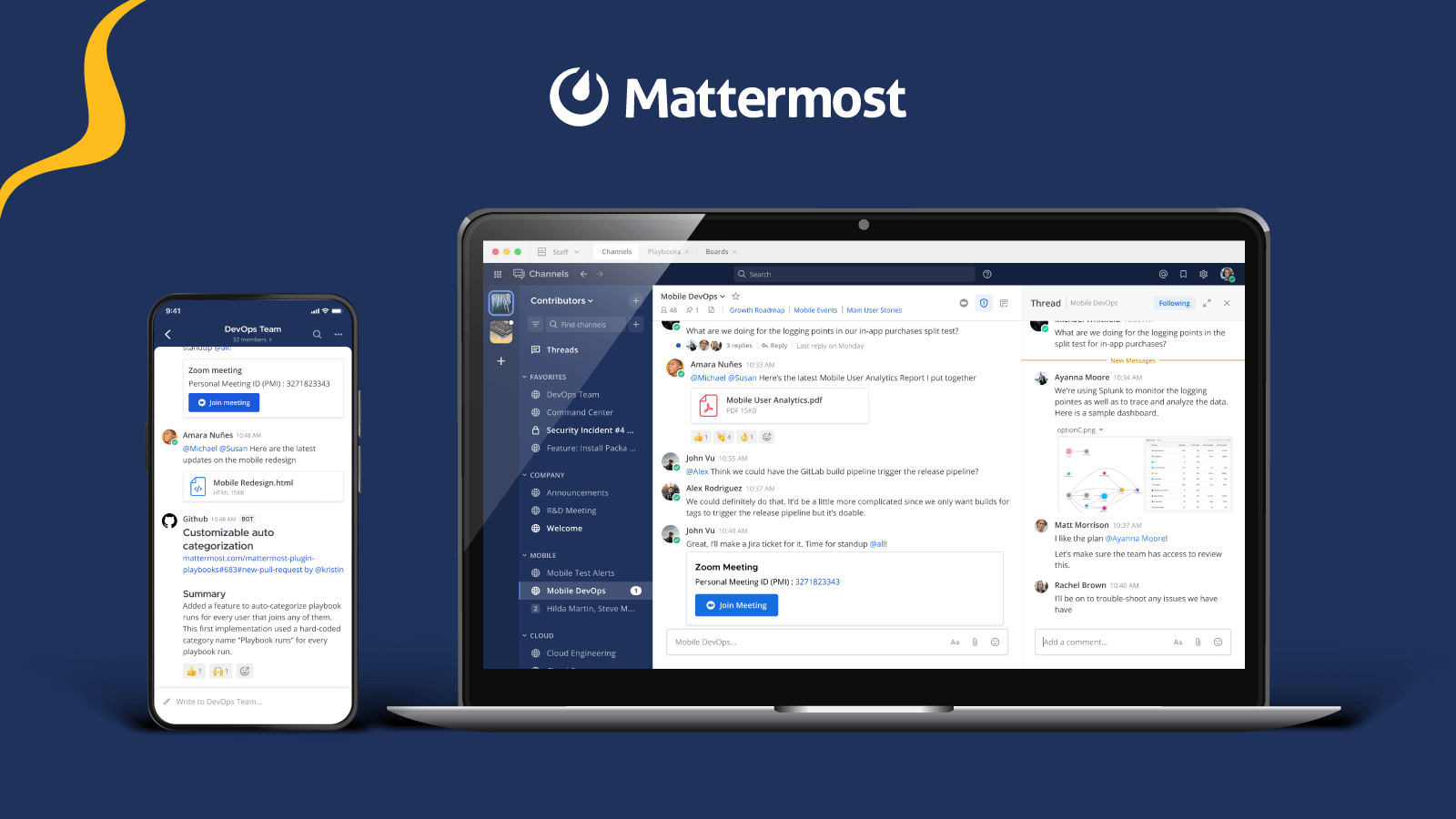
Mattermost is built to be that operating environment. Playbooks codify incident response into structured processes with owners, task checklists, automated triggers, status updates, and built-in retrospectives, so activating the war room means activating a defined process rather than creating a channel. Role-based access controls with custom permissions, scoped channels, and compliance exports keep visibility, retention, and evidence inside the customer’s environment, ready to be pulled as a single record when the regulator or the board needs it. On-premises, private cloud, and air-gapped deployment options put the war room inside the same boundary as the rest of the security infrastructure — the same control plane that governs the data, governs the conversation about the data.
And the v11.7 Tool Policy Editor — covered in last week’s post — scopes what agents can do per context, including during an incident in progress.
Some of that is mature and running in production deployments today. Some of it is still being hardened for the use cases that put the most weight on it — coalition operations, classified environments, high-assurance regulated response. The direction is consistent across all of it: the collaboration surface where the incident actually runs should be governed at least as well as the surfaces where less consequential work happens.
A war room design session at SRM
If you’re at Gartner SRM 2026 in National Harbor and the post-incident review your team wrote this year contained a version of the sentence “we need to figure out what we do for the war room next time,” that’s the conversation worth having at Booth 303.
Bring the review. We’ll sit down for 30 minutes and design what a governed war room would look like for your environment specifically — what’s in the room, who’s in it, what comes out of it when the incident closes, and where the gaps sit between your current platform and what CIRM is asking for. You’ll leave with a concrete sketch, not a brochure.