



Disconnected, degraded, intermittent, and low-bandwidth (DDIL) conditions are no longer rare disruptions. For today’s defence operations, they are the everyday environments in which missions must succeed.
Understanding DDIL: The New Mission Reality
Imagine a coalition task group operating deep in a mountainous region, where weather disrupts satellite coverage, units move in and out of range, and networks flicker without warning. Yet commanders are still expected to coordinate across nations, languages, classification levels, and domains, often with only minutes to act.
In these environments, failure to maintain collaboration isn’t just inconvenient. It can compromise mission tempo, fracture coalition cohesion, and put lives at risk.
Why DDIL is the Norm, Not the Exception
DDIL — disconnected, degraded, intermittent, and low-bandwidth conditions — is no longer a contingency. It is the default environment for many operations.
Land forces moving through remote terrain. Naval groups at sea for extended deployments. Air and space missions relying on vulnerable satellite links. Cyber teams defending under active disruption. Across every domain, adversaries know defence communications are the first target and exploit DDIL relentlessly.
Ukraine has underscored this reality: contested networks are attacked early, often successfully, to slow response times and fracture coordination. NATO and coalition forces must now assume DDIL will define their operating environment, not the exception.
The Operational Cost of Communication Disruption
When continuity breaks, the consequences cascade. A delayed order can cost tempo. An intelligence update that fails to reach the right team puts lives in danger. Coalition partners working from different data sets create confusion that adversaries can exploit.
Downtime doesn’t just slow operations; it erodes trust. If commanders cannot rely on their collaboration platforms under pressure, they hesitate to act. Hesitation is exactly what opponents seek.
Technical Requirements for DDIL-Ready Collaboration Systems at the Tactical Edge
Forces operating in DDIL environments require collaboration platforms that are built to withstand disruption, not collapse under it. That means:
- Built for the edge: Collaboration, tasking and coordination must continue even on narrow or unstable links.
- Seamless data continuity: Mission data must sync automatically the moment connections return, without duplication or loss.
- Federated, sovereign control: Nations need assurance that sensitive data stays within their boundaries, with only agreed artifacts shared across partners.
- Playbooks under pressure: When conditions degrade, automated workflows should trigger proven responses, ensuring tempo continues without pause.
These aren’t aspirational features — they are mission requirements that decide whether operations keep moving forward or grind to a halt.
Four Critical Lessons for NATO and Coalition Partners
Resilience at the tactical edge cannot be an afterthought. It must be designed into the systems and workflows defence organisations rely on. Four lessons stand out:
- Resilience must be engineered in. Platforms designed for office productivity cannot be patched for the battlefield.
- Zero Trust must persist under disruption. Identity, verification, and auditability cannot fail just because bandwidth does.
- Sovereign systems matter. Nations must retain control of their data and collaboration infrastructure without dependence on non-sovereign SaaS providers.
- Human-machine teaming is critical. AI can surface insights and propose actions at machine speed, but continuity depends on commanders making informed decisions quickly and with confidence.
Deterrence and readiness are measured by tempo under pressure. In DDIL conditions, missions do not pause — and neither can the systems that support them.
Continuity at the tactical edge is more than technical resilience; it is the foundation of trust, tempo, and coalition cohesion. For NATO and its partners, building platforms that perform in the toughest conditions is the difference between resilience and risk, between unity and fragmentation, and ultimately, between deterrence and escalation.
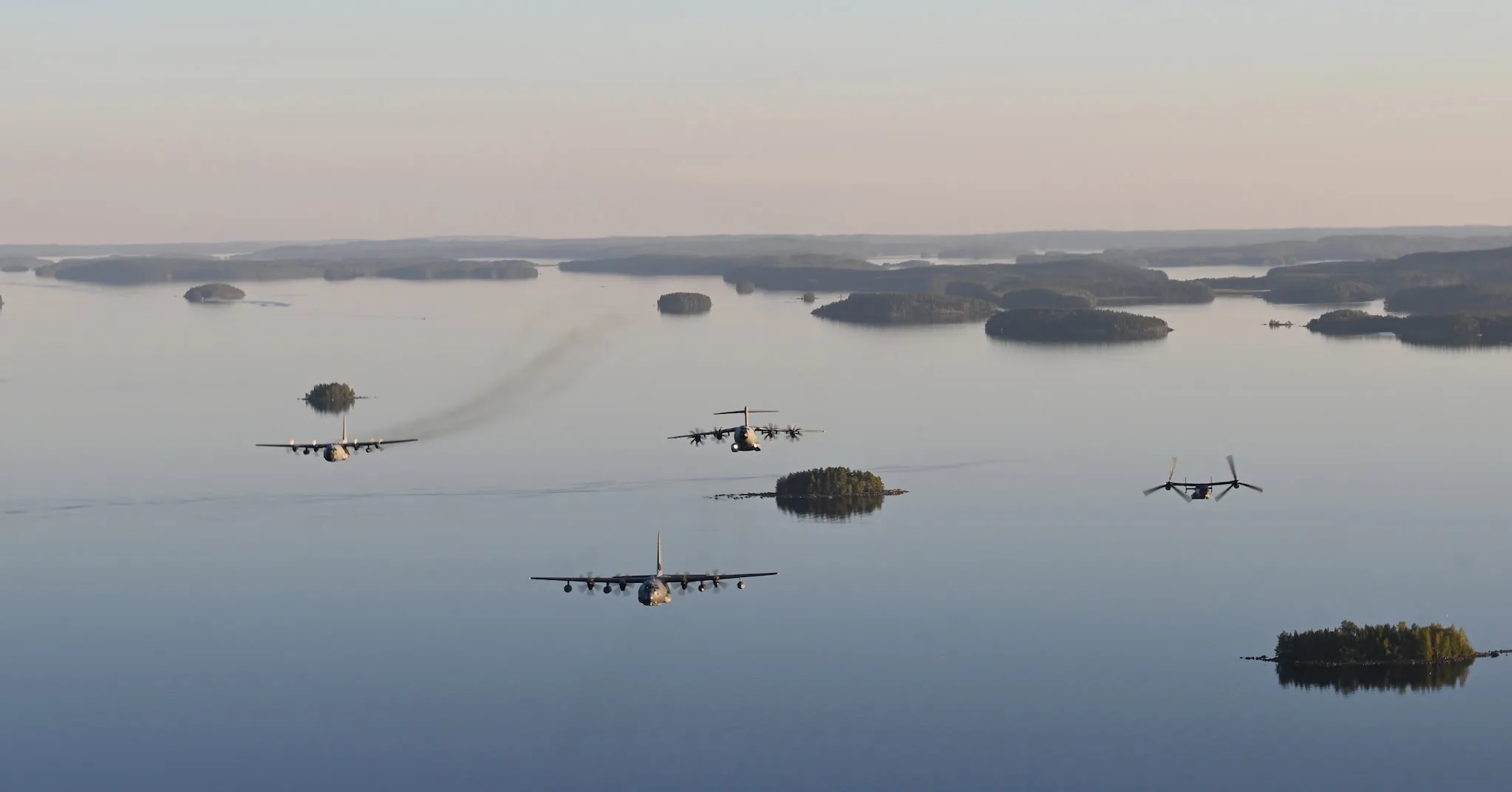
Image: A U.S. Air Force CV-22B Osprey and MC-130J Commando II from the 352d Special Operations Wing fly in formation with a German A400M Airbus and French C-130H Hercules during Exercise SOUTHERN GRIFFIN 25, above Finland, Sept. 4, 2025. Source.
The appearance of U.S. Department of Defense (DoD) visual information does not imply or constitute DoD endorsement.